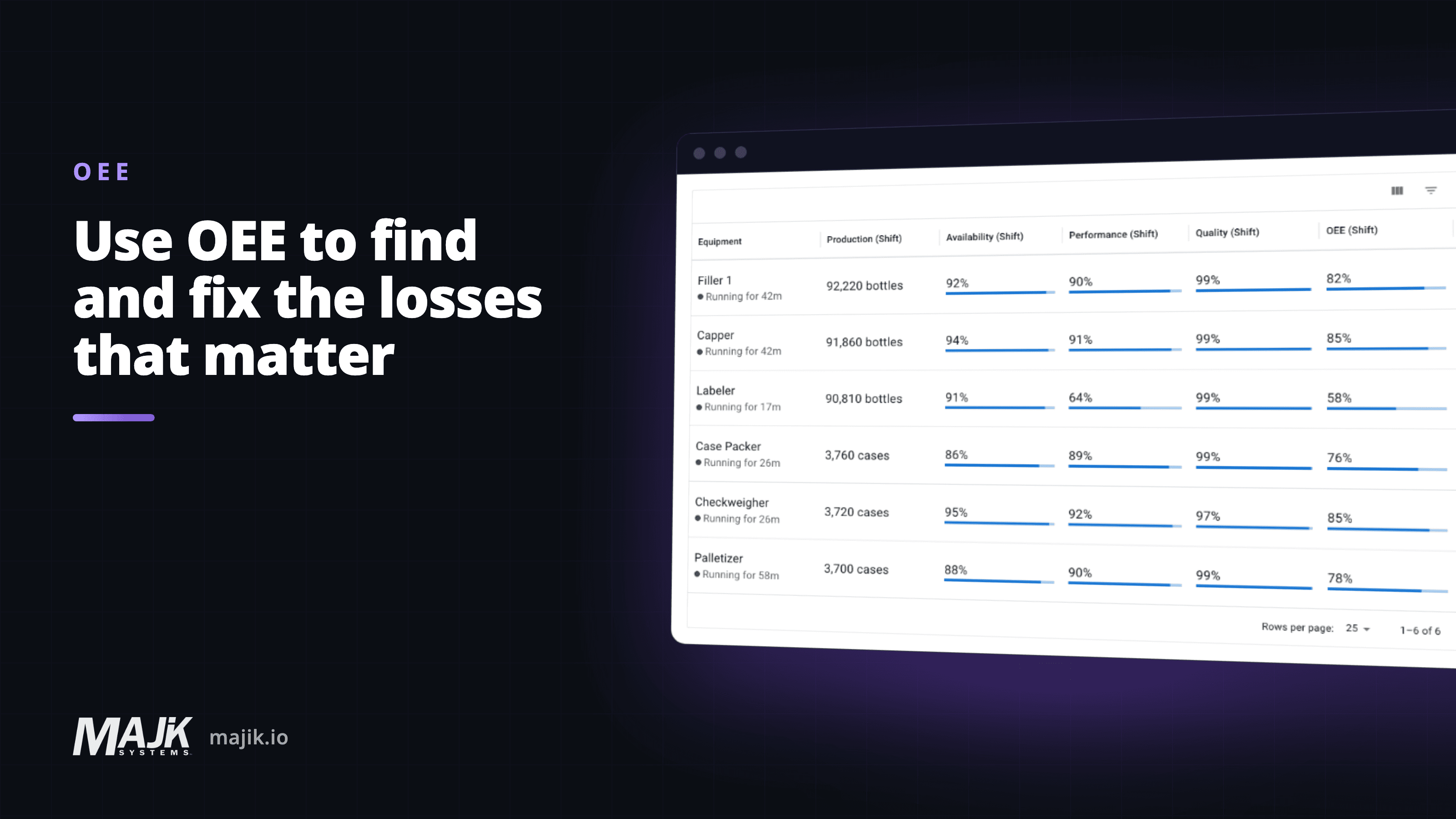
From spreadsheets to live OEE: a 90-day shop floor rollout
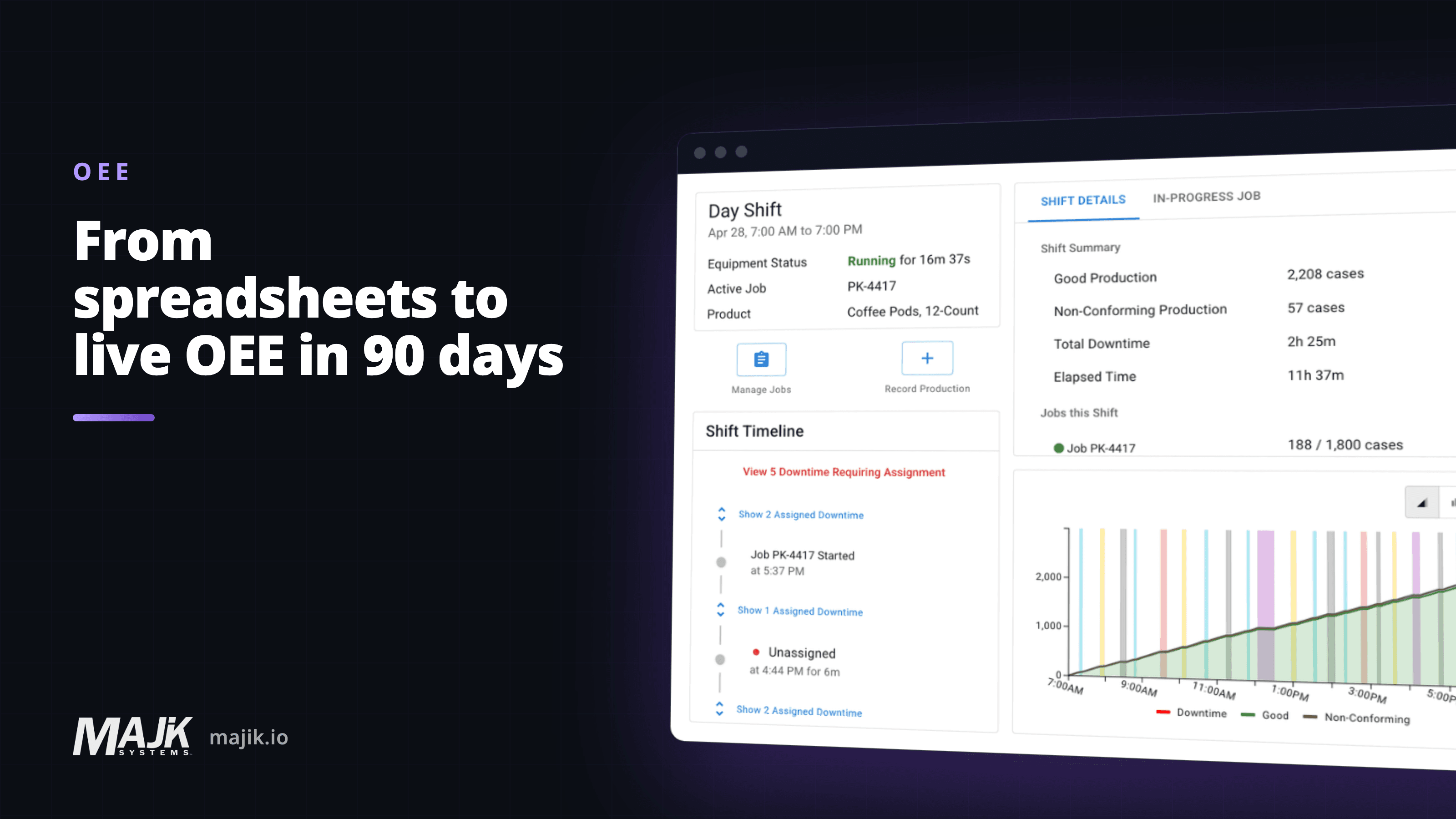
Every shift ended with twenty minutes of transcribing counts into a spreadsheet, and nobody read it until the next morning. That was the starting point for a packaged-goods producer that moved to a live number everyone on the shop floor could see, in ninety days.
What did the spreadsheet actually cost?
More than the twenty minutes it took to fill in, which is the part that usually gets counted.
What the spreadsheet was really costing:
- Every stop was news the next morning, after the shift that could have fixed it had gone home.
- A busy operator cleared stops and never logged them, so the record was wrong before anyone read it.
- The first half hour of every monthly review was spent reconciling counts that had all been typed in by hand.
None of that appears as a line item, which is why it survives for years.
Which losses did the team name before measuring?
An OEE score says the line lost time. It does not say whether the fix is on the filler, the machine that fills each pack, or in the changeover. So before instrumenting any line, the team agreed on which losses mattered most: unplanned downtime on the primary filler, and slow cycles after changeover. Each loss maps to a different fix, so naming them first kept the rollout focused.
Which losses paid for the project?
- Unplanned downtime on the primary filler, where a five-minute stop also stopped the downstream packer.
- Slow cycles after changeover, when operators ran conservatively until they trusted the setup.
Do you need new controllers to start?
No. MAJiK IoT Connect reads running status and counts from the PLCs already on the line, plus weights from a serial scale. It reads the controllers and never writes to them, so there's no change to how the line operates. The first useful trend appeared the same afternoon the gateway came online.
How does a tag become a trend?
A tag is a value the PLC already keeps, such as whether the filler is running or how many good units it has made. Each one was mapped once, then reused across the dashboard, the alerts, and the AI assistant. The mapping is the durable asset; the views are easily added afterward.
Mapping a machine is a few commands: name the controller, then name the values that mean running and a good count. MAJiK IoT Connect watches the run bit, the value that says whether the machine is running. When it flips to stopped, IoT Connect sends a start event, and when it flips back, an end event. A stop arrives as that pair of events, following the usual start and end pattern, rather than a stream of readings someone has to compare. The serial scale is another entry in the same list; it does not need its own installation.
Where does the number need to be seen?
The dashboard only changed behavior once it moved off a manager's laptop and onto an overhead display the crew could see. When operators watched the same trend in real time, the slow-cycle loss shrank without a new policy.
Three things made that display work:
- The crew can read it without logging into anything.
- The target rate sits beside the actual rate, so the gap is the message.
- A stopped machine shows how long it has been down, and that clock keeps running, so a five-minute stop on the filler is visible in its first minute, not in tomorrow's spreadsheet.
Where did the ninety days go?
Mostly into definitions. The connection was finished within the first two weeks, and the technical work was the predictable part. The rest of the time went into deciding what a changeover was, when it started, and whether a planned stop counted, because those are decisions the factory has to make and nobody outside it can make for them.
That is also what the team would do differently. Settled in week one, on a whiteboard, before any number appeared on a screen, those definitions would have shortened the rollout considerably, because most of the ninety days went into them.
If you are starting your own rollout, settle these before anything gets instrumented:
- How much changeover time is expected, and when it becomes unplanned downtime.
- Which planned stops count against OEE, and which are considered non-operational time.
- Which machine tags identify a changeover and the other stops worth capturing, so they are recorded automatically.
- Who signs off on the definitions, so they are not reopened every month.
Nobody spends the last twenty minutes of a shift transcribing counts anymore. The number is on the overhead display while the crew can still act on it, and the definitions, settled once, hold for every line after this one.
See what a line looks like once the number is live in OEE and production monitoring.
Frequently asked questions
How long does a first line take to go live?
- Live machine data on a first line in 8 days is a realistic target. The ninety days in this story covers the rest: adding lines, agreeing on what the losses are called, and getting the number trusted on the shop floor.
Do you have to replace controllers to get live OEE?
- No. This rollout read the PLCs and the serial scale that were already on the line. Nothing was replaced and no control logic was touched.
Who needs to be involved?
- Someone who owns the losses, someone who can get you onto the network, and the supervisors who will use the number every shift. The last group decides whether it sticks.
What makes the number trusted rather than argued with?
- Reconciling it against what the factory actually made, early and in public. Once a supervisor has checked the count against their own tally and it matched, the arguing stops.
Where should the number be displayed?
- Where the work happens. An overhead display the crew can see without logging in changes behavior in a way a report emailed the next morning does not.
Related: live OEE and production monitoring, and how a MAJiK rollout works.
About the author
Jeff MacLeod
Key Account Manager, Enterprise
Jeff runs MAJiK's enterprise accounts and the systems analysis calls that start them, where a factory walks him through eleven machines and he works out which ones can actually be read. He has had the "our equipment is too old for this" conversation enough times to know how it usually ends.